The Glossary of American Football Part I

One of the most popular sports in the United States and Canada is rapidly gaining preference in other parts of the world as well. For the vast majority of punters, while it is available in all of the top Asian and European bookmakers, the nuances, terms and mindset involved, is completely new and foreign. It’s time that we make the introductions, so that people may start understanding what the sport is all about. In fact, it is a quite complicated one. Let’s begin.

The Football field

All of the stadiums have exactly the same dimensions. 100 yards long separated every 10 yards indicating the minimum distance that a team has to cover when attacking to maintain the right to advance. Another 10 yards on each of the edges denote the touchdown zones. Players must catch and maintain full control of the football inside these zones for a scoring play to count.

At the outer edges, in the middle, you can see the uprights which are iron constructions shaped like a reverse 2-pitch fork.  A vertical bar 10 feet high connects with a horizontal crossbar 18 feet and 6 inches long with 2 vertical bars at each end extending another 35 feet (at least) high. The uprights are used when a team kicks the ball attempting to score a field goal. The football must pass within the limits set by the 35-foot-long bars.

The teams

At every instance of a match, there must be 11 players from each side lining up to play. Contrary to other sports, a football program can have more than 35 players in total for every game separated in special teams. There is the defensive, the offensive, the punting, the kicking and the returning units, to name the main ones.

  • The defensive unit
    As the title says, these are the players responsible for stopping their opponents from scoring either a touchdown or a field goal. Each player has a position designation and a very specific role. Let’s just mention those here and we will extend the descriptions later. Here we have Defensive Ends, Defensive Tackles, Linebackers, Cornerbacks, Free Safeties and Strong Safeties.
     
  • The offensive unit
    Every time a team gets the ball, they have 3 attempts to advance a minimum of 10 yards. If they make it, they can continue until they are either stopped, or manage to score. These units feature the most important player in American Football, the Quarterback. They are the brains of the unit and responsible for deciding and making the plays. The other position designations are halfbacks, tailbacks, running backs, guards, tackles, tight ends and wide receivers.
     
  • The punting unit Punter
    When the offensive unit fails to advance 10 yards after 3 attempts, then they must punt the ball to the other team. The prominent figure here is the punter. He is supposed to kick the ball as far away as possible from his team so that when the other side takes over, they will have to cover as much distance as possible. He must catch the ball after the snap and then kick it in the same way a goalkeeper kicks the ball in soccer after a save.
     
  • The kicking unit Kicker
    There are three instances that this unit is deployed. In an attempt to score a field goal, an attempt to score the extra point after a touchdown and the kick-off after a scoring play. The key players here are the holder and the kicker. The holder receives the ball from the snap and spots it on the ground for the kicker. He is not necessary on the third of the aforementioned instances, as the ball is placed on a tee before the kick-off.
     
  • The returning unit
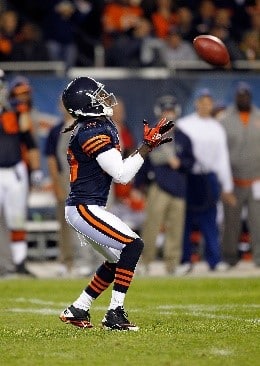
    Returner Every time there is a kick-off or a punt, the receiving team lines up this unit where the prominent figure is the returner. He is supposed to catch the ball and attempt to run towards the touchdown zone of the kicking or punting team, trying to cover as much distance as possible, in order to provide his offensive unit, the best starting position possible. He has the choice of indicating a «fair catch» which means that after he catches the ball, he will not attempt a run. In that case, if he catches the ball inside the touchdown zone, then the offensive unit starts at the 20-yard line. Otherwise, the starting position is the yard line that the returner caught the ball.

For the punting and kicking units, another key player is the long snapper. He is supposed to throw the ball at least 10 yards behind him for the holder or the punter.

Scoring Plays

As expected, the winner of a match is the team that scores the most points. There is a number of ways that this can be achieved:

  1. The touchdown
    Every time a player of the offensive unit catches are brings the ball (after achieving full control) inside the touchdown zone of the defensive unit, his team is awarded 6 points.
     
  2. The field goal
    If a kicker kicks the ball above the horizontal crossbar and between the uprights, his side is awarded 3 points.
     
  3. The extra point
    After scoring a touchdown, a team can score one more extra point by kicking the ball between the uprights in the same way a field goal is scored.
     
  4. The 2-point conversion
    Again, after having scored a touchdown, a team that is 2 points behind in the total score, can spot the ball on the 2-yard line and attempt to score a second touchdown. Only this one is awarded 2 points instead of 6.
     
  5. The defensive safety
    When a defensive unit manages to stop either the quarterback, or the running back, inside their own touchdown zone, their team is awarded 2 defensive safety points.

The first part of our glossary of American football ends here. In the other parts, we will discuss about the details of each player position, where they are supposed to stand and the legal formations of each unit. We will also discuss about the main infractions and the punishments that can be imposed. All of it is important information that you need to know before you register for an account via agent and start betting on this sport.

BET-IBC
Прокрутить вверх