


Sports Bets Trading: Big wins if you know how.
Introduction

The traditional way of placing bets is simple. A bookmaker offers a set of odds for various markets (outcome, handicaps, over/under, etc…) inviting people to place their bets on whichever result they think will bring them the most profit. Punters then hand their stakes to the bookie and wait for the event to end, to see if they won their bet or not. If the first is the case, then they collect the payout. Otherwise they loose their stake.
Over time, the demands of the bettors forced the betting establishments to modify their products in order to satisfy all needs. Under this notion, processes like the cash-out system and the introduction of betting exchanges where you can find a process for the trading of bets between players, have been developed. The latter is known as sports trading. You can browse through our betting services via agent to select the exchange that you fancy the best.
Most ordinary players, consider the issue to be quite complicated and do not want to get involved. However, we think that this is a mistaken notion and here is our chance to change your minds. Let’s discuss on the issues involved.
The definition
The premise is similar to a stock exhange where, the most important rule to profit out of the endeavour, is to “buy low and sell high”. You buy a stock at a price and then you sell it at a higher one to pocket the difference. This is what happens on sports trading with one notable difference. In the stock market you can use only one stock. To trade bets you need 2 bets:
- One “back” bet and
- One “lay” bet
The notion requires that you use a betting exchange where you get to play against other players and where you can place “lay” bets (a service that is not offered by a standard Sportsbook). Let’s remember what is a “back” and what is a “lay” bet:
- A “back” bet is a bet in favor of an outcome. If, for example, on a match between Liverpool and Everton, you believe that Liverpool will win, you “back” the Reds.
- A “lay” bet is a bet against an outcome. To use the example above, if you “lay” the team from Anfield, you think that they will not win. This does not mean that the Toffies will win. There is also the draw as an outcome. So, actually a “lay” bet gives you more options than a “back”.
The point of the exercise
To put it in plain terms, the whole point is to secure profit. As aforementioned, if you do not trade and you loose a bet, you forfeit all of your stake (the cash-out system notwithstanding). When you trade bets you actually make sure that you will receive a payment out of the process.
What you need to do
Let’s put what we have discussed so far in an actual bet.
 You do your homework.
The first thing you need to do is to check all the available information about an event, so that you can be as sure as you can be, about an outcome.
- Pay attention to the odds.
The prices offered by the bookmakers can rise or drop according to the new data that becomes available. If you pay attention then you will see when the odds for a back bet are satisfactorily higher than the odds of a lay bet or vice versa.
- Know WHEN to place your bets.
The crucial point is the timing of your bets. On this issue there can be no better way to explain it, with an example:Let’s assume that in August, the odds for Juventus to win the Italian title is 4.00. If you take the price and place a bet of € 100 and the bet is won, then you stand to pocket € 400 for a profit of € 300.
Let’s now assume that in May, the situation is that Veccia Signora is 6 points ahead of the pack and there are 3 rounds left. There are indications (here is where the homework pays off) that the situation might change and there are enough games left for this to happen. At this time lay bets against Juventus are offered at, let’s say, 1.20. To hedge your position you take the offer. The only decision you need to make is how much of the profit of the first bet you are willing to lose. Let’s set the amount to € 150. So you place a lay against Juve of € 150 x 1.20 for a liability of € 30.
Let’s see what happens:
- Juventus wins the title. You get the € 400 from the first bet and lose the liability of € 20 from the second. Net profit: € 280.
- Juvenuts does not win the title. You loose € 100 from the first bet and pocket the matched portion of our second bet, i.e. € 150. Net profit: € 50.
- Use the appropriate software.
What we have described so far requires that you do a fair amount of work. Fortunately, there are plenty of trading software applications that can do this for you. It would be to your best interests to select the one that you can safely use and let it do the work for you.
The bottom line
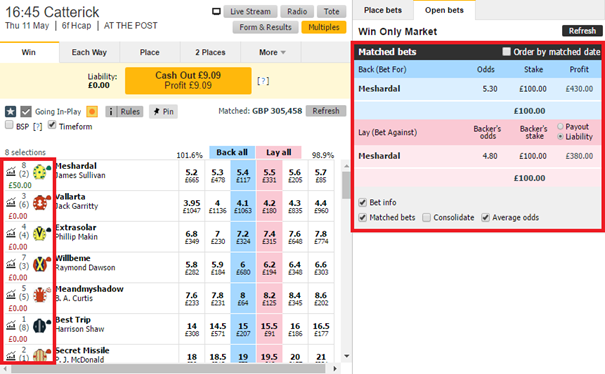
Through the example that we presented above, you usually stand to make the most profit if you stick to the usual way of Sportsbooks. However, you also stand to loose all of your stake. By doing some smart trading, it is quite certain that you stand to make a reasonable profit every time. Maybe not as much as you could, but what we suggest does take out any chance that you may loose your stake.
All you have to always remember is that sports trading is all about playing the odds. However, to play with the odds, you need to know the odds. While one exchange or another may provide some good deals, if you decide to implement the exercise, then your best option is to have every price that is available, side by side on the same screen. That’s what our best betting software does for you. Here’s your chance! You just need to take it.