


This is probably the most important term in American Football. When a ream gets the ball, the quarterback and its offensive crew comes to the field. To keep advancing the must cover a distance of 10 yards. This is called a first down.On TV there is a digital system indicating a yellow line indicating the yardage that must be covered.
On the field however, this is not visible. For the players to know where they should get to, there is a system of chains that is placed at the beginning and the end of the distance, along with a number that shows the attempt. In fact, there is an entire crew charged with this task.To achieve the goal, they have three attempts. The first one is also called «first down». The next one «second down» and then «third down». Every attempt is followed by the remaining distance to cover. So, when you hear «second and five», it means that the team must cover 5 years during their second attempt. Respectively, a «third and inches», means that the team needs to cover less than a yard in their 3rd attempt.
If they do not manage to cover the distance in three attempts, the fourth down usually brings up the punting team. However, the attacking team still has the option to play the ball regularly with the offensive crew. If they still cannot make the distance the ball switches hands at the spot of the further advance instead of the distance that would have been covered by the punt.

This is how the match restarts after the completion of every play. The ball is spotted at the point of the furthest advance in the previous play, or at the point that results after the addition or deduction of the yardage that was imposed after a penalty. The snapper gets one hand on the ball and when the quarterback gives the order, he throws it to him for the next play to begin. The snapper also throws the ball to the punter, or the spotter during special teams plays.
- The Line of Scrimmage :
The spot where the ball is placed for the next play to begin, forms a vertical line to the direction where the game is progressing, and parallel to the touchdown zone. Both teams line up to each side of this line. The only player that is allowed to be over the ball is the snapper. The rest of the players need to be 11 inches behind or in front of this line. This is called the neutral zone and no one is allowed to cross this zone before the ball is snapped.
The LOC also determines the position of each player on the field as described in the second part of our glossary

After receiving the ball from the quarterback (or if the QB keeps the ball himself) and starts running down the field, then he is a runner. There’s a specific significance in that. Runners are not subject to the same foul or holding calls that the rest of the players are. Opponents can grab them, tackle them, trip them and in general have more options in stopping their run to the in-zone. Runners can stop their run whenever they want, as long as their left knee touches the ground.
- The Receiver :
Similarly to the runner, anyone receiving a thrown pass (as opposed to a hand-off) from the quarterback is a receiver. It does not matter if his original position was a running back, a tight end or a wide receiver. Since, after the reception, they become ball carriers, the same rules for contact as the runner apply.
- The Interception :
This is what defenders live for. It’s actually their one of two chances to score points. When a quarterback throws a pass, if they can catch the ball before the intended receiver without committing pass interference, then they practically have a free run to score a touchdown.
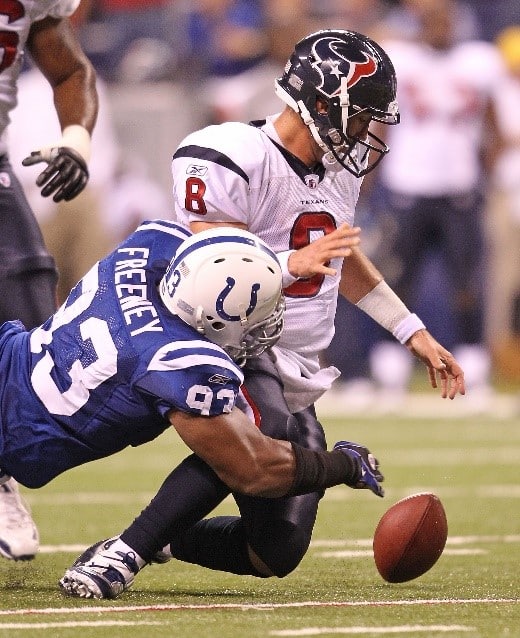
Runners and receivers need to keep the ball under complete control. Here we need to discuss the difference between an incomplete pass and a fumble. An incomplete pass from the QB to any runner or receiver is considered a pass where the intended player either never received the ball (without it being intercepted) or did not bring it under complete control before it touched the ground. If the receiver does receive the ball, brings it under complete control and then drops it (or an opponent knocks it away from his hands), then it’s a fumble.
A second difference is that, in the case of an incomplete pass, the ball is dead and the play stops. The team that had possession loses a down and the ball is placed at the same spot for the next play, as in the failed attempt. In the case of a fumble the ball is very much alive and every player can claim it. It’s the second chance that the defenders have to score. If they recover a fumble from an attacker, their way to a touchdown is pretty much clear and it all depends on their own pace (get to the in-zone before an opponent catches them) and the ability of the blockers to protect him.
- Pass plays:

An interesting part here is that if a defender manages to get to the quarterback and hit his hand then:
a) If the hand was not moving forward, it’s ruled as an incomplete pass
b) If the hand had begun the forward motion, it’s a fumble unless a personal foul is called.

Here, the QB more or less hands-off the ball to the running back starting his run behind him. The front line of the offense has to open a corridor to the defensive line for the runner to pass through. Alternatively, they can block the defensive backs towards the center, so that the runner can find away on the outside of the line. Rush plays are the most vulnerable to holding calls.
- The Blitz
Sacking the quarterback is another thing that defenders live for. The Blitz is a technique (dangerous one) where the defenders try to outnumber the QB protective line, so that one of them can have a clear path to the QB. The most usual case of using it, is on a third and long (3rd down with a distance of more than 10 yards to cover due to a penalty) as the most usual practice from the quarterback is to throw the ball to cover the distance (rush plays rarely cover more than 5 yards). In such a case the QB protection is usually minimal, allocating players to receiving positions.
- Defenseless receiver :
This is one of the most interesting rules in American Football. As mentioned in a previous part of our Glossary, a defender cannot touch a receiver before the latter catches the ball. In fact, it is a bit more complicated. The defender cannot touch the receiver immediately after the latter catches the ball. If the receiver is in the air, then the defender has to wait until he comes back to the ground. The rule here is the «3-steps». The defender can «hit» the receiver after he takes 3 steps when catching the pass. The rule was implemented to prevent injuries that occurred when the receiver could not actually defend himself against a «hit».

After a kick or a punt, the receiver on the other side can waive his hand in the air before catching the ball, indicating that he has no intention of advancing after the catch. He can do this if, in his judgement, there is no possible path to gain any yardage. In such a case, the players of the kicking team are not allowed to touch him.
He can also indicate a fair catch by kneeling down on his left knee right after the catch.
- Lateral passing :
The usual passing procedure has the quarterback receiving the ball from the snapper, throwing it to a receiver who then turns and runs towards the opponents’ in-zone. This is the only forward pass that is allowed. However, there are plays where you will see many players passing the ball between them. This is legal as long as the player that makes the pass, throws it backwards and not forwards. Note, that the position of the receiver of the pass makes no difference. The passer cannot throw the ball forwards even if the receiver was behind him when the pass was made.
There are plays where the quarterback throws a pass to another registered quarterback who then makes the forward pass. As of last year, the rule changed and this play is valid only if the first pass is lateral. It’s a risky proposition as if the ball is dropped, it is considered a fumble and not an incomplete pass.
- Challenging :
This is a rule that has existed in American Football for quite a while and is gradually being introduced in other sports. The head coach of a team can challenge a decision made by the official if there is clear evidence that it was incorrect. To indicate the intent, he must throw a red flag on the field (to indicate an infraction, officials throw a yellow one). An important detail here is that the coach must be precise on what exactly he is challenging.
When a red flag is thrown the referee approaches the coach and receives the exact details of the challenge. Then he reviews the video of the play and determines if the challenge is worthy according to these details. If the challenge is successful, then the decision on the field is amended. If not, the team that made the challenge loses a time-out.


While in many sports, Canada and the U.S.A. are considered as one, this is not the case for football. In the NBA for example, teams from either country play in each other’s courts. This is not possible for football as the Canadian fields are considerably larger than the American ones. To be precise, they are 10 yards longer and 12 yards wider. Also, the in-zone is 10 yards long in the U.S.A. pitches, while the relevant area is 20 yards for Canada. A third difference comes with the placement of the uprights. In the United States they are located at the end of the in-zone, while in Canada they are at the score line.

|

|

This is a sport where appearances are just deceiving. It looks like a violent, take no prisoners, brutal opposition, when in fact it is anything but. The rulebook is quite long and heavy and does not allow for anything that may result in an injury due to the course of the play. Not that it doesn’t happen. However, nowadays, players getting hurt is more a result of carelessness than intent. We did not reference it in any of the parts, but a major part for the protection of the players is due to the equipment that they now carry. A set that costs between 1,100 and 1,200 U.S. dollars for each professional player.
Speaking of the equipment, modern day football has embraced a lot of communication possibilities that technology offers. For example, the quarterback wears an in-ear wireless headset to receive instructions from the head coach. Some QBs also wear small tablets in a protected pocket of their arm pads where they can see and select any of the plays that have been rehearsed.
Most importantly, it’s a sport that does not allow for wrangling behind the scenes. Every decision can be reviewed through video and changed if an error was made by the officials. And that makes for a world of difference to the punters, knowing that it is probably the cleaner sport in existence.